
Case Study:
stony hill mixing
Seeds of Innovation: How Stony Hill Mixing Automated Its Way to Success.
In the quiet world of wild bird seed, few might expect to find cutting-edge automation and robotics revolutionizing production. But nestled within this niche industry is Stony Hill Mixing, Ltd., a Millersburg, Ohio company that has not only embraced innovation but has also redefined how small businesses can scale smartly and sustainably.
Founded in 2001, Stony Hill Mixing is a manufacturer of high-quality wild bird food for their sister company, Lizzie Maes Bird Seed. Lizzie Maes, founded in 2009, distributes wild bird food to a network of 550 to 600 specialty stores across the United States. Unlike big box retailers, Lizzie Maes Bird Seed targets mom-and-pop shops that value the superior quality of the Stony Hill Mixing products.
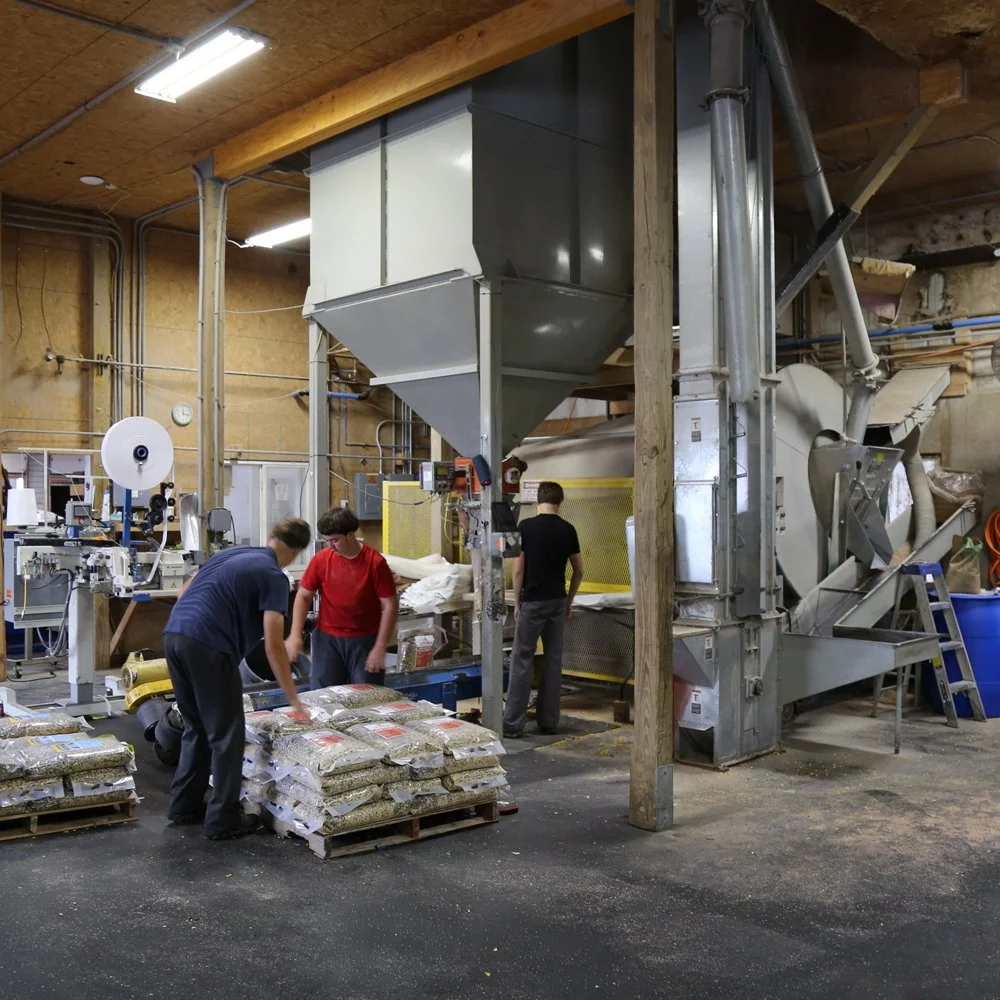
The original batching process was all done manually, ingredient by ingredient. Accuracy was a guessing game and processing was slow.
Operational Challenge Prior To Automation
Stony Hill Mixing’s commitment to excellence is evident not only in its seed but also in how it has evolved its operations to meet surging demand without compromising on quality. At the heart of this transformation is a state-of-the-art automated batching system from Ingredient Masters located in Batavia, Ohio near Cincinnati. This system, in conjunction with automated packaging and palletizing equipment, has propelled the company into a new era of efficiency.
"We were mixing all our own product manually," says Michael Yoder, General Manager of Stony Hill Mixing. "The batching was done by loading seed into a mixer sitting on load cells, ingredient by ingredient. Accuracy was a guessing game."
Before automation, the team had to manually feed ingredients into the mixer via a bucket elevator. Each addition required careful monitoring, and inaccuracies were common. The absence of a pre-batch system meant slow processing speeds and greater potential for errors. The reliance on labor-intensive methods made it difficult to scale operations effectively.
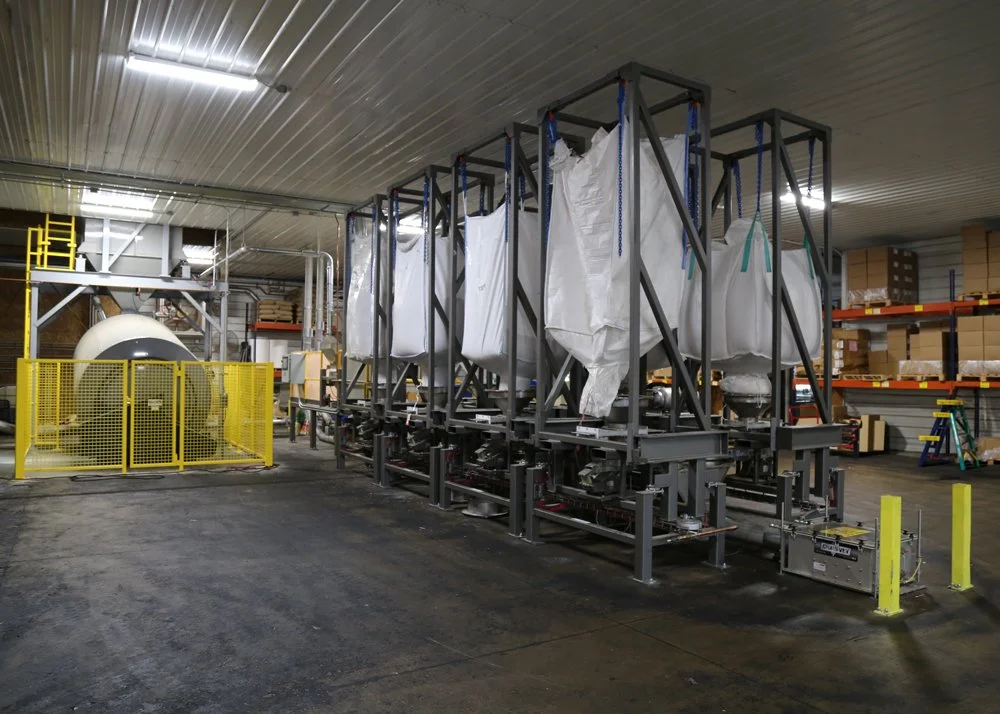
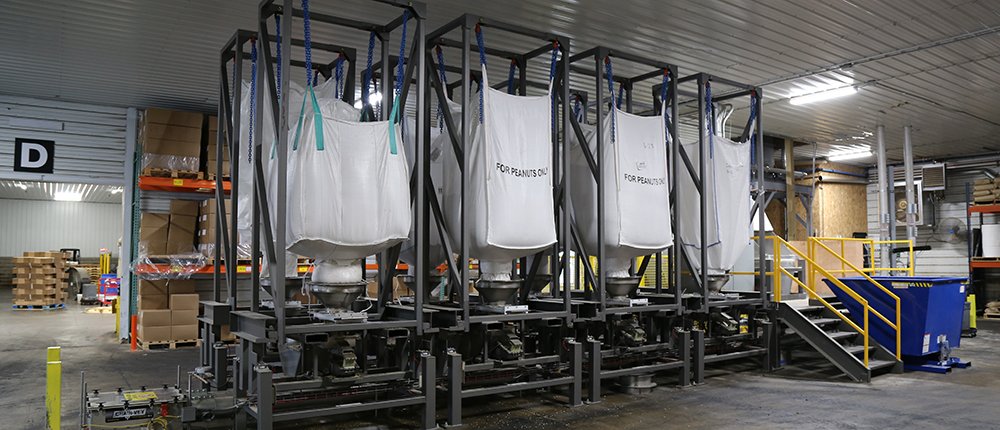
The Ingredient Masters automated batching system offers pre-batch hoppers, automated ingredient dispensing, and highly accurate weighing capabilities.
Implementation of an Automated Batching System
The installation of the Ingredient Masters system has changed that completely. It introduced pre-batch hoppers, automated ingredient dispensing, and the ability to weigh materials with high accuracy. According to Yoder, this has at least doubled—if not tripled—their mixing output.
"This single automated line is run by just two people now," he explains. "One on the batching side and one on packaging. Previously, we needed six people across two manual lines to achieve just under what this one line now produces daily."
Integrated Production Line and Process Control
The benefits extend beyond labor reduction. With built-in accuracy in weighments, the new system ensures consistency and minimizes waste, an essential factor when dealing with high-cost specialty ingredients. The batching system also feeds directly into an automated Barry-Wehmiller bagger and a Fanuc robotic palletizer, streamlining the entire production line from start to finish.
"Any batching system requires a balance between speed and accuracy. We worked with Stony Hill Mixing to find the best mix for their operation," says Mike Gasaway, President of Ingredient Masters. “And, we are constantly adjusting the system to get more speed and better accuracy as we monitor their process,” he adds.
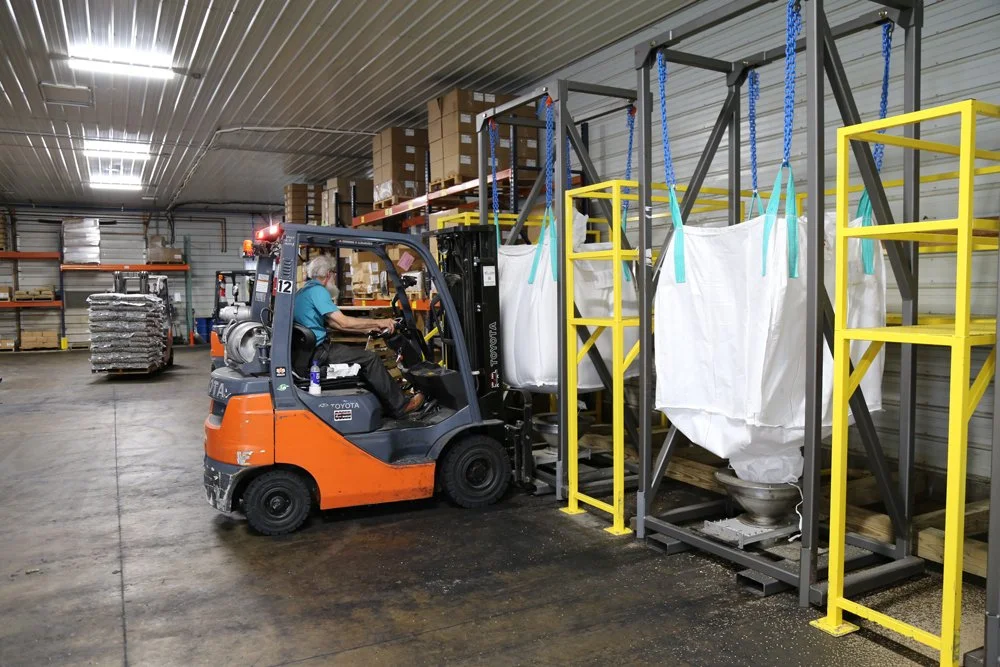
Removable tote-hanging stations equipped with adjustable chains allow for varying bag sizes.
Material Handling Flexibility and System Design
This automation is no small leap for a business that once relied on screw conveyors and human eyes to monitor scales. Now, with programmable logic controllers (PLC) managing ingredient flow and recipe execution, operators can simply select a batch and walk away to perform other tasks. Even the raw materials delivery system—a chain conveyor network pulling from grain silos—is integrated into the PLC for full control.
"The PLC manages everything," Yoder explains. "It controls the dispensing, the chainvey, the pre-batch hopper, even the robot on the packaging end. It's all synchronized."
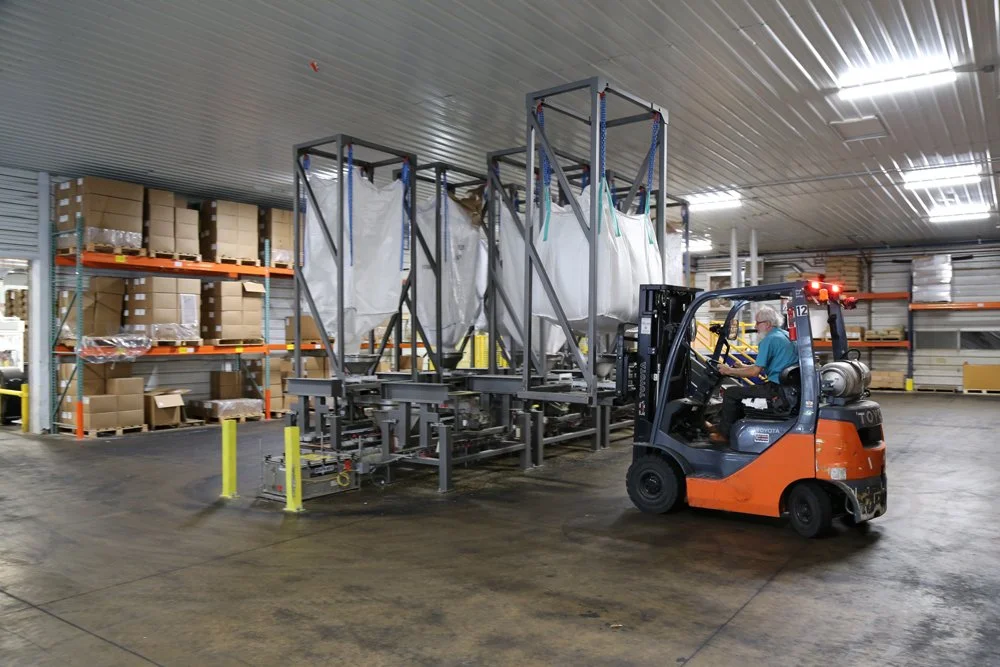
Fast raw material dispenser replacement is crucial to maintaining high system performance. Additionally, the entire system was designed to work within the limited ceiling height available.
Approximately 70% of raw materials come in supersack bulk bags, while the remainder arrives via bulk trucks and is stored in silos. The system accommodates both, using removable tote-hanging stations equipped with adjustable chains for varying bag sizes. The removable tote-hanging stations load directly into a vibrating feeder and make product replenishment fast and easy. This flexibility is crucial, allowing Stony Hill Mixing to run 8000-pound full batches consistently—the equivalent of four bulk bags per batch.
“This is a very unique batching system with the tote-hanging stations. Our biggest curveball was working with the limited ceiling height. We typically have 25-30 feet of height to work with, but we only had 15 feet where this system was installed,” notes Gasaway.
The batching system is also equipped with a hand-add section for ingredients that can't be automated. "We have 10 to 12 hand-add ingredients," says Yoder. "Some recipes need none; others require a good amount. The hand-add hopper weighs and dispenses those as well."
"It's not just about the big, bulk ingredients," he adds. "The smaller, specialty components make a huge difference in the final blend. Having a system that can handle those seamlessly makes our job a lot easier."
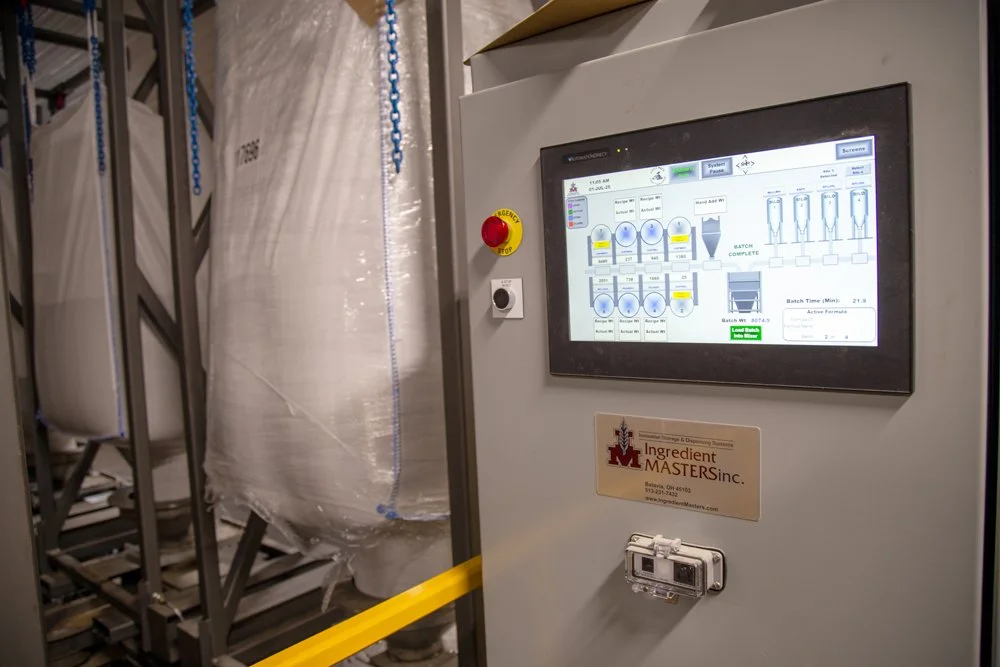
System control is accessible through a touch-screen display. Recipes can be saved, adjusted and deployed quickly.
Recipe Management and Production Capacity
Currently, the system manages about 20 to 25 recipes, with capacity to expand to as many recipes as needed. This capability gives Stony Hill Mixing the agility to add new SKUs and adapt to market demand. Each recipe can be customized, saved, and easily adjusted based on seasonal requirements or customer preferences.
"We're targeting high-volume sellers with this line, and we run full batches," Yoder explains. "With all bulk bag ingredients, we can move around 100 tons a day. That means someone is hanging 100 bulk bags daily."
That volume, managed by only two operators, reflects not only the efficiency of the system but also the strategic foresight behind Stony Hill Mixing’s operational planning. It illustrates a commitment to both growth and quality.
System Reliability, Support, and Future Growth
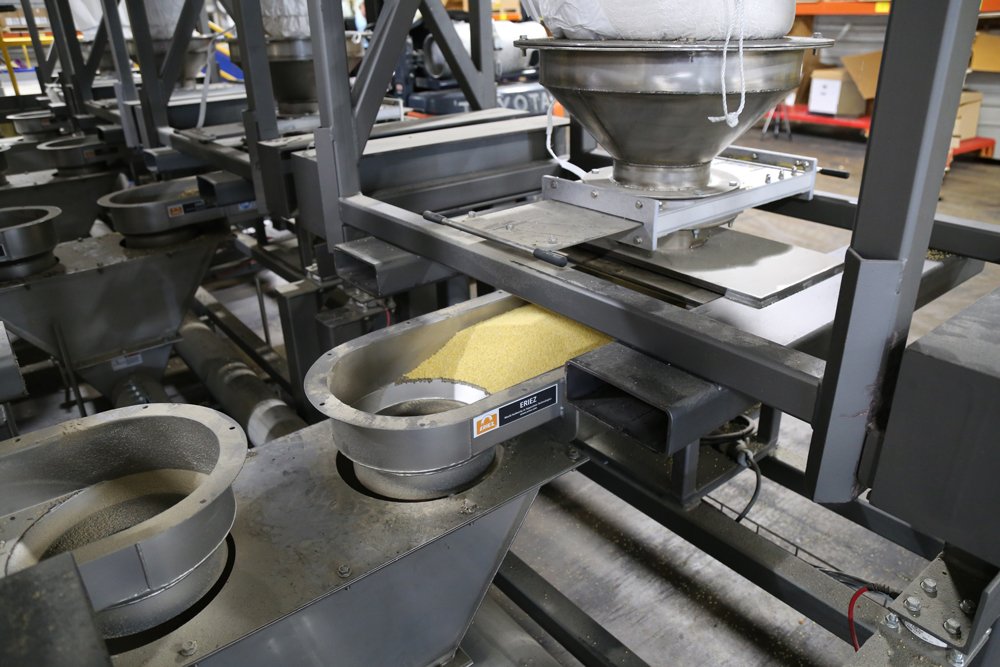
Bulk bags hung from removable tote-hanging systems load directly into vibrating feeders which feed a chainvey system.
Even with such throughput, reliability remains strong. Initial hiccups with the PLC were quickly resolved, thanks to responsive support from Ingredient Masters. "Any time we had an issue, a phone call and 10 minutes later we were up and running," says Yoder. "Since then, no breakdowns—the equipment is purring right along."
That level of service is something Yoder doesn't take lightly. "Great service creates repeat customers and separates good companies from great ones," he emphasizes. "They’re responsive, knowledgeable, and proactive. That makes a huge difference when you’re relying on technology every day."
Looking ahead, Stony Hill Mixing sees opportunity not just in growing its production but in expanding its product range and customer base. The flexibility built into the new system allows for experimentation with new blends and faster go-to-market timelines. It also opens the door for private label opportunities and customized mixes for regional markets.
"We’re no longer bottlenecked by production limitations," Yoder states. "If a customer wants something unique or we see a new trend emerging, we can pivot quickly. We have been blown away by how well the Ingredient Masters systems works.”
A Model for Modern Small Manufacturing
From humble beginnings to high-tech automation, Stony Hill Mixing is a case study in how even small, specialty businesses can scale dramatically with the right technology and partners.
"At the end of the day," Yoder says, "we're just trying to make the best birdseed we can and get it to the people who care about quality. But we’ve learned that embracing automation doesn’t mean losing our personal touch—it means freeing ourselves up to do more of what matters."
As the birds keep coming, Stony Hill Mixing is more than ready to feed them—and the growing demand. Their journey is not just one of efficiency, but one of evolution. And in that journey, there’s a lesson for any small business with big dreams: smart growth starts with the right foundation.